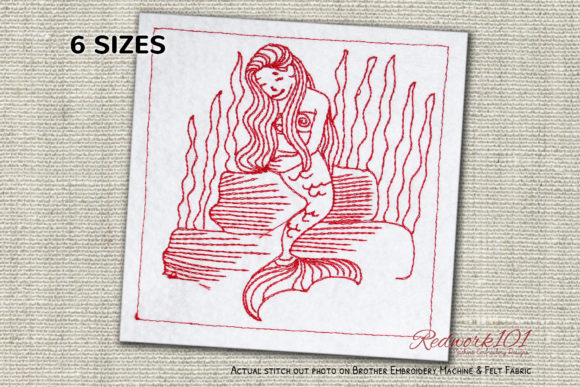
Mermaid Sitting on Rock Lineart Embroidery Review
When I first opened Mermaid Sitting on Rock Lineart, I immediately thought of coastal boutiques, handmade soap brands, and those charming little cafés that want their merch to tell a story. This isn't a loud, overly complex design. It's a clean lineart piece that carries a quiet confidence — the kind of artwork that feels both whimsical and intentional. As an embroidery designer who has digitized hundreds of files for small business clients, I can tell you this: designs that balance personality with simplicity are the ones that actually make it onto finished products. And this one lands in that sweet spot.
The Mermaid Sitting on Rock Lineart design belongs to the Marine Mammals category, which makes sense given the subject matter. But what I appreciate as a professional in the Embroidery field is how the lineart approach keeps the stitching manageable. Too many business owners fall in love with highly detailed artwork that turns into a dense, stiff mess on fabric. This design, by its very nature, sidesteps that problem. The optional box stitch mentioned in the product description is something I'll touch on later — it's a thoughtful inclusion that gives you flexibility depending on your brand aesthetic.
First Impression and Visual Personality
As soon as I examined the linework composition of Mermaid Sitting on Rock Lineart, I could see it fitting into a range of brand styles. The mermaid seated on the rock gives off a calm, reflective vibe — there's nothing rushed or cluttered about the silhouette. For a small business, that translates to a design that feels established rather than trendy. Trendy designs have a short shelf life. This one has a timeless quality that won't make your merchandise look dated six months from now.
The lineart style means the design relies on clean outlines and thoughtful negative space. That's a huge advantage for machine embroidery design work because it keeps the stitch density in a comfortable range. I've seen too many patch designs where the artist tried to pack in shading, gradients, and tiny details that simply don't read well in thread. Mermaid Sitting on Rock Lineart avoids that trap entirely. The simplicity is the strength here, and that's something I always emphasize to clients who are new to ordering custom embroidered goods.
Where This Design Excels in Small Business Merch
Let me walk you through where Mermaid Sitting on Rock Lineart can genuinely perform for your brand. I'm not talking about hypotheticals — these are real applications I've seen work repeatedly for my own clients in the handmade and boutique space.
Embroidered Patches for Apparel and Accessories
This design is a natural candidate for an embroidered patch. The lineart structure means the patch edges can follow the mermaid and rock silhouette beautifully, especially if you skip the optional outer box stitch. A die-cut patch with this artwork sewn onto denim jackets, canvas backpacks, or beanie caps would look intentional and premium. For Etsy sellers and craft business owners, offering Mermaid Sitting on Rock Lineart as a standalone patch creates a low-cost, high-perceived-value product that customers love to collect and display.
Apron Embroidery for Cafés, Bakeries, and Studios
One of the first scenarios that came to mind was a small coastal bakery or a pottery studio using this design on staff aprons. An apron embroidery placement on the chest or upper bib area would give the uniform a bespoke, handcrafted feel. Because the design is lineart, it won't overpower the apron or compete with other branding elements like a logo. The Mermaid Sitting on Rock Lineart works as a subtle brand accent rather than a loud advertisement — and that's exactly what builds customer trust over time.
Cap Embroidery for Casual Branding
Cap embroidery is notoriously tricky. Curved surfaces, structured panels, and seam lines all conspire against detailed designs. But a lineart piece like this one has a fighting chance on a cap front. The open spaces between the lines allow the cap fabric to breathe, reducing the puckering and distortion that plague dense fills. I would recommend testing Mermaid Sitting on Rock Lineart at a slightly reduced size on a low-profile dad cap or a five-panel hat to see how the outlines hold up. Every hoop size and cap frame will yield slightly different results, so run at least two test stitch-outs before committing to a bulk order.
Tote Bag Design for Retail and Gifting
A tote bag design featuring this artwork would resonate strongly with customers who shop at boutiques, bookstores, and eco-conscious markets. The mermaid-on-rock imagery carries an organic, natural-world association that pairs well with brands focused on sustainability, handmade goods, or ocean-inspired products. I've seen similar lineart embroidery on canvas totes become the item customers reach for daily — and every time they do, your brand gets free visibility. The relatively low stitch count of a lineart file also means faster production time per bag, which matters when you're fulfilling wholesale orders or preparing for a busy market season.
Brand Identity and Customer Perception
When a small business invests in custom apparel or branded merchandise, every design choice sends a message. Mermaid Sitting on Rock Lineart communicates creativity, thoughtfulness, and a connection to nature or storytelling. That's valuable real estate in your customer's mind. A brand that uses a mermaid motif signals imagination and a touch of magic — without veering into childish territory. The lineart treatment keeps it sophisticated enough for adult apparel, which is a critical distinction if your target audience skews toward professionals or gift buyers.
From a brand identity standpoint, consistency matters. Using the same embroidery file across multiple products — patches, uniforms, tote bags, and even product packaging accents — creates visual cohesion. When a customer sees the Mermaid Sitting on Rock Lineart on a café apron and then again on a retail tote, they begin to associate that specific artwork with your business. That kind of visual consistency builds recognition faster than any logo alone. I always advise my clients to pick a signature embroidery motif and use it relentlessly across their product line. This design is strong enough to fill that role.
Practical Embroidery Designer Notes
Before you send Mermaid Sitting on Rock Lineart to production, let me share the testing checklist I use for every digital embroidery file I work with. These steps have saved me from costly misprints and unhappy clients more times than I can count.
- Test in black and white first. Run a single-color stitch-out on scrap fabric in black thread on white material. This reveals any registration issues, density problems, or awkward line spacing without the distraction of color choices.
- Check performance at small patch sizes. Scale the design down to 2 inches, 2.5 inches, and 3 inches in width. Observe whether the mermaid's features — especially the face, hands, and tail details — remain legible. Lineart designs can close up at tiny sizes if the original artwork has tightly spaced lines.
- Review thread color contrast. The product description notes that the outer box color is separate from the main design unless it's integrated into the artwork itself. You can skip the box entirely, which I often recommend for patches and apparel. If you do keep the box, test how the border thread color interacts with the main lineart color on your chosen fabric.
- Inspect spacing between elements. The space between the mermaid's tail, the rock, and the optional outer box should be wide enough for thread to lay cleanly without merging. If lines are too close together at your target size, the embroidery can become a blurry mess after a few washes.
- Confirm your hoop size. Don't assume the file fits your machine's standard hoop. Measure the design dimensions in your embroidery software and verify against your available hoops before loading fabric.
- Test on real fabric. The fabric you'll actually use for your finished product — not just practice muslin — should be part of your test run. Canvas, denim, twill, and jersey all behave differently under needle and thread.
- Use proper stabilizer. For tote bags and caps, a cutaway stabilizer is non-negotiable. For lighter fabrics like apron cotton, a tear-away may suffice, but I lean toward cutaway for anything that will see regular washing.
- Create a printable mockup for client approval. If you're digitizing Mermaid Sitting on Rock Lineart for a client, generate a printable mockup showing the design on their actual product. This manages expectations and prevents the "it looked different on screen" conversation later.
- Compare beside other design assets. If your brand already uses other embroidered elements, lay out the stitch-outs together. Check that Mermaid Sitting on Rock Lineart feels like part of the same family in terms of scale, line weight, and overall presence.
- Confirm commercial licensing. Before using any embroidery file for business merchandise, verify that the license covers commercial embroidery use. Selling finished products with someone else's design without proper licensing can create legal headaches you don't want.
Where to Use Mermaid Sitting on Rock Lineart With Care
No design is perfect for every application, and I want to be honest about where Mermaid Sitting on Rock Lineart needs extra attention or should be reconsidered entirely.
Very small patch sizes under 2 inches may lose the finer details of the mermaid's form. The rock shape could become indistinct, and the tail might read as a blob rather than a recognizable element. If you need a tiny chest accent or a sleeve detail, test first and be prepared to simplify further in your digitizing software.
Cap fronts with heavy structuring can distort the rock base of the design. The curved surface of a structured cap means the lower portion of the embroidery may sit differently than the upper portion. I've seen lineart designs where the bottom third looks compressed because the cap curve wasn't accounted for during hooping. Use a cap-specific hoop and adjust your digitizing for the arc if needed.
Textured fabrics like fleece, terry cloth, or heavily napped materials will swallow fine line details. If your brand uses plush hoodies or textured towels for merchandise, the Mermaid Sitting on Rock Lineart design may not read clearly. Stick to smoother substrates like canvas, twill, denim, or tightly woven cotton for best results.
Dark uniforms with dark thread can hide all the careful linework. Contrast is your friend in embroidery. If your brand colors are navy and charcoal, consider using a lighter thread for the lineart or adding a subtle fill behind the design to make it pop against the fabric texture.
Items needing frequent industrial washing — think restaurant uniforms or healthcare scrubs — demand extra testing. Lineart stitches can be delicate compared to filled areas, and repeated high-heat washing may cause thread breaks over time. Reinforce the digitizing with appropriate underlay stitching and consider a poly-core thread for durability.
Final Production Thoughts for Business Owners
After reviewing Mermaid Sitting on Rock Lineart from a professional embroidery perspective, I can confidently say it holds real value for small business merch, branded patches, and boutique product lines. The lineart approach gives you a versatile design asset that adapts to multiple products without overwhelming the finished piece. For Etsy sellers building a cohesive shop aesthetic, for handmade brands that want recognizable product packaging accents, and for local businesses investing in custom apparel that customers actually want to wear — this design delivers.
What sets Mermaid Sitting on Rock Lineart apart from more generic embroidery options is the mood it carries. It's calm, coastal, and quietly distinctive. Those are qualities that translate into higher buyer engagement and better-perceived product value. Customers recognize when a brand has put thought into their merchandise, and a well-chosen embroidery motif signals exactly that level of care. Whether it's stitched onto an apron, sewn as a patch on a tote bag, or centered on a cap, this design helps a business look established, creative, and intentional. In the crowded world of small business branding, that's an edge worth having.