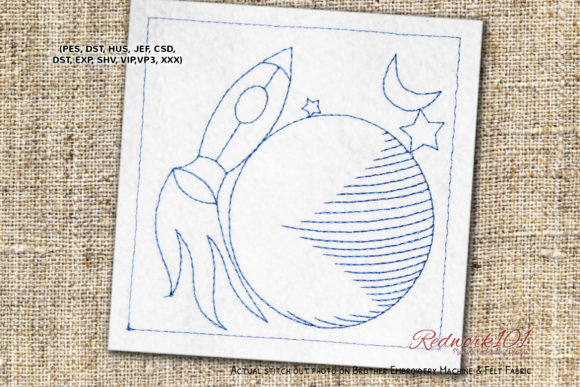
Rocket Going from Earth to Moon: A Designer’s Real-World Review
When you’re scanning through embroidery files for a project, you’re not just looking for a pretty graphic. You’re looking for a solution. Will this design stitch out cleanly? Will it resonate with a client or customer? Does it have the right personality for the final product? Today, I’m putting the Rocket Going from Earth to Moon design through that exact lens, imagining it stitched onto real fabrics and sold in real shops.
The Immediate Mood: Nostalgic Charm with Modern Clean Lines
First impression matters, and this design strikes a specific chord. The rocket’s trajectory from a simple, stylized Earth to a detailed Moon creates a story in a single frame. It’s not a hyper-realistic space scene; it’s more of a clean, graphic illustration. This gives it a playful, almost nostalgic feel—think classic sci-fi book covers—but executed with crisp lines that modern embroidery machines love. For a creative entrepreneur, that’s a great starting point: it’s approachable, not too technical, and carries a universal theme of exploration and achievement.
I immediately picture this on a child’s baby embroidery item, like a quilt or a nursery wall hanging, or as a personalized gift for a graduate or someone starting a new venture. The mood is optimistic and slightly whimsical, making it highly giftable. The layout is balanced, with the central rocket path drawing the eye. The detail level seems intentional: the Earth and Moon aren’t overly dense with fill stitches, which suggests it should perform well without creating stiffness in the fabric.
Where This Rocket Design Shines in Real Projects
Let’s get practical. Imagine you’re preparing a batch of embroidered tote bags for a local boutique. You want designs that are distinctive, stitch reliably, and add value. The Rocket Going from Earth to Moon fits here perfectly. Its clear, defined shapes mean satin stitches for the rocket and fill stitches for the planetary bodies should come out with good stitching clarity. On a mid-weight canvas tote, this design would become a focal point, elevating a simple bag into a handmade product with a story.
For custom apparel, like a cotton sweatshirt or a teen’s t-shirt, this design offers versatility. It’s not overly masculine or feminine; it’s simply cool. As an embroidered patch, it would be fantastic—the optional box stitch mentioned in the description could frame it neatly for a patch application, adding to that retro space mission vibe. For small shop merchandise like pillow covers or kitchen towels, it introduces a fun, thematic element without being kitschy. It feels like a design that would perform well in digital product previews and printable mockups, helping Etsy sellers present it attractively.
A Specific Scenario: The Holiday Gift Sweatshirt
Picture this: a client requests a custom embroidered sweatshirt as a holiday gift for their nephew who loves astronomy. You pull up this machine embroidery design. You consider size and placement. Because the design has a strong central graphic, it would work well on a left chest or centered on the back. You’d advise the client that on a textured fleece fabric, using a good stabilizer is key to keep the Moon’s details sharp. The result? A unique, thoughtful gift that feels professionally made, not generic. This is where a design’s visual appeal directly builds customer trust in your service.
Careful Considerations: Where to Tread Lightly
No design is universally perfect, and honest review means noting the caveats. The description notes an optional box stitch, and that “the color of the outer box is a different color in most of the designs unless it is part of the design itself.” This is a crucial detail to check in the actual embroidery file. If the box is a separate element, you must ensure your software handles color changes smoothly, especially for a craft business running multiple items.
For very small hoop sizes, the finer details of the Moon’s surface might lose definition. I’d be cautious putting this on highly stretchy fabric like a thin t-shirt without excellent stabilizer, as the fill stitches could pull. On dark fabric, the contrast needs to be planned—a bright white or silver thread for the rocket trail could be stunning. Also, be mindful of curved surfaces like caps. The design’s linear rocket path might need careful orientation to look balanced on a curved crown.
The design falls under the Robots category, which is interesting—it suggests a broader theme of machinery and exploration. This isn’t a dense, complex robotic design, however. Its simplicity is its strength, but it means on large areas like blankets, it might need to be scaled up or complemented with other elements to feel substantial.
The Impact on Your Business and Craft
Using a design like this isn’t just about stitching; it’s about the final finished product. For an apparel decorator, it adds a unique option to your catalog, moving beyond standard logos. For a digital product seller, it’s a design asset with clear application potential that customers can visualize. Its clean execution enhances professionalism in your work; a messy stitch-out would ruin the charm, but a clean one makes it look expertly crafted.
It boosts brand consistency if you, say, run a boutique focused on science or education-themed goods. For holiday embroidery or wedding gifts (perhaps for a couple passionate about space), it offers a personalized touch that generic store items lack. That specificity increases buyer engagement. They’re not just buying a bag; they’re buying a symbol.
Essential Designer Notes Before You Stitch
My absolute rule: test the design on scrap fabric first. Use the same fabric and stabilizer you plan for the final project. Check how the optional box stitch integrates. Review the stitch density on your scrap—does it feel appropriate for your intended fabric weight? Inspect the small details, like the transition from Earth to the rocket’s path.
Always check thread color contrast against your background fabric. Run a test on both light and dark scraps if you plan to offer the design on various materials. Confirm the effective hoop size needed from the file itself. And, vitally, confirm licensing before selling finished items or digital products. Ensure your use, whether for personal projects or commercial embroidery, is covered.
Finally, consider fabric texture. A smooth cotton will showcase the design differently than a textured towel. Using proper stabilizer is non-negotiable for clarity. Remember, the design’s value is fully realized only when it’s stitched well. The Rocket Going from Earth to Moon has the potential to be a standout in your portfolio, but like any good tool, its success depends on your skilled application. Plan its journey from file to fabric thoughtfully, and it will deliver a delightful final product.